Sunday, May 24, 2015

Agarita Adventure


I wish I could recall the entire conversation I have been having with myself for the past 3 hours while I sorted agarita* berries (NO, I am not finished, but I needed to take a break). We came home with what we thought would be about two quarts of berries (it is hard to tell because there is so much extra stuff in with the berries**).

The gist of my conversation is that, had I lived "way back when" and the survival of my family depended on me harvesting and canning agarita jelly, we would likely have ended up in boot hill sooner than later:

"Dang. This is hard." 
"This takes forever for just a handful of berries." 
"My feet hurt." 
"I could be reading a book." 
"No wonder women used to die so young on the prairie, they worked too hard." 
"If I was canning figs I would have a shelf full and be sitting down with a book by now."

And another thought - "This better be the best thing I have ever tasted!"

Okay, why I am doing this? I like to make preserves and a friend had hundreds (thousands?) of agarita/algerita bushes. We talked about harvesting some of the fruit and making jelly. My sister has always said that she loved agarita jelly, so I thought I would try it.

We received word from our friends that the berries were ready and stopped by our their property on our way back from our trip to the river. We "beat the bushes" for about 30 minutes.

Agarita/algerita/algerito/agritos * (the spelling is just like I like it - sound it out and write something down)
These guys were doing such a good job harvesting (you basically beat the branches and the berries fall on the tarp or bucket or umbrella you put underneath. I did help them earlier but was dodging the sticks and flying berries and withdrew to take photos. I understand that a video exists. [It is the end of May. Look how green this place still is!]

From soldiers to farmers...it could happen.
See all the stuff in with the berries? Look closer.
We released two of these true bugs before we closed up the container to load it into the car, but I found three that we missed during the sorting. Also see the small bright green thing in the lower right hand corner? That is a piece of cactus. Sorting was slow going for a reason.

Perhaps I should mention here that DH is always a little concerned that I will forage for food in the wilds around here and poison him/us. There is a simple response to this concern. I don't forage much. I only gather things I know. I am well aware that there are many poisonous plants in the woods so, I am cautious. He doesn't eat plants anyway. Mostly I take photos.

DH is not worried about the agarita. First, his good army buddy, " I would trust him with my life," is the one leading him from shrub to shrub. Second, DH doesn't eat jelly. So, I guess he's safe.

OK. I sorted, sorted, sorted some more, sorted (ouch! sharp leaves!), and sorted.

It is slow going.
Sharp leaves sorted out.
Starting to pile up (aren't they pretty?
[A number of things happened in here that I did not take photos of. You can read the steps below. You can imagine a pretty red juice, no? Okay.]

Boiling water bath - 10 minutes

The berries are soaking in hot water right now.

After 30 minutes I mashed them with my potato masher. 6 Cups of berries = just more than 4 Cups of juice (for heaven's sake!).

I drained the juice and measure it. Then I followed the rest of the recipe below.

Here are the results. Pretty, no?


Sample sized jars waiting for the boiling water bath.


NOTES:

*http://aggie-horticulture.tamu.edu/ornamentals/nativeshrubs/mahoniatrifol.htm

**What is in with the berries, you ask? Well, two different varieties of true bug (you know them by the triangle shape on their backs), one grasshopper, cactus that my friend told me was especially nasty (it looks like asparagus, but it is not benign), fire ants, spiders, stems, and spiked leaves. That is what I have noted so far. All the critters were dead by the time I found them. I didn't want anything crawling out into the frig or kitchen so I sealed the fruit in a plastic container and put that inside a plastic bag (tying the bag in two knots). That "done 'em in." There will be no protein in this jelly.

***http://www.wildedibletexas.com/2012/04/agaritas.html [I am sticking with this recipe as the blogger appears to know what she is talking about.]

Agarita Jelly Recipe
Makes 2 pints
Slightly tart and perfectly sweet, the soft-red colored agarita jelly is a Texas treat on everything from biscuits to peanut butter and jelly sandwiches.
4 c agaritas
1 package of pectin
1 Tbsp. lemon juice
¾ c sugar per cup of agarita juice
Place agaritas in a bowl or pan and pour hot water over the berries just until covered. Let sit for 30 minutes then mash vigorously with a potato masher to release the juices. Strain through cheesecloth or a jelly bag and squeeze thoroughly to extract all of the juices. Measure and pour the juice into a pot and add the pectin and lemon juice. Bring to a boil then add ¾ c sugar per cup of agarita juice and stir constantly. Bring to a boil for 2-4 minutes. Test the liquid to see if it will gel by taking a spoonful out, letting it cool, and then pouring it back in. If some of liquid runs together into a sticky sheet, it’s ready to gel. Pour the hot liquid into sterilized jars, place the caps and rings on tightly and boil in a hot water bath for 10 minutes. Note: This recipe does not make a lot of jelly so if you plan on eating it within a few weeks, you don't need to can it and process in a hot water bath. Simply put in in airtight containers and store it in your refrigerator. [From WildedibleTexas.com]

Friday, May 22, 2015

Two boys from a small town

I have written about him before,* my great uncle John. He had always been a bit of a mystery to me. My knowledge of him was limited. I knew about him from the big granite stone in the family plot and an odd family story. I knew a little from his letters home** - first from the farm and then from the war (John was quite the joker - a bit sentimental and sometimes formal in his letters). After my father died, I found a speech Daddy gave at the VFW Post that was named for John. He was the only boy from his home town to die in WWI.

Then I learned more about John as a Marine from his military records. I had gathered my maternal grandfather's records (all three pages of them***) a few years ago. After that I wrote for my paternal grandfather Hal's records, expecting very little. That package of records - over an inch thick - included a copy of a letter from my great grandfather. Between the lines was a story of brothers - of love and loss. So finally I wrote for Uncle John's records. Another large and complete package arrived.

Uncle John's military records disclosed the color of his eyes and the color of his hair. I discovered that he was only 5'6" at enlistment.**** He had a few scars (what farm boy doesn't). I put my fingers on his fingerprints that were part of his records (and wished for a photograph).

But I had never seen John's face.

Oh, maybe he was present in some blurry old photo observed when I was a kid and cared nothing about such things. But now that it mattered to me, I discovered we had no photos of him.

After much inquiry, I discovered a cousin with photos. She recently shared those photos with me.

So, here he is with his older brother, Hal. Upon learning that war had been declared, these two young men - farmers from a small town in south Texas - went to the recruiting center and attempted to join the Marines. Uncle John passed the physical, while Hal did not. A month later the Navy took Hal.

Hal served as a guard/gunner on troop ships and traveled frequently from the United States to France. He was able to visit with his brother when he was in France on at least two occasions (One of John's letters expressed gratitude for the tobacco Hal brought him). They also found the time to take a photo to send home to their mother.


Hal and John *****

John was a muleskinner.****** His records tell the story of the campaigns he was in. They tell of his awards. And they tell of his death in France days before his 21st birthday and a month before the end of the war.


John and Hal*******


So, on this Memorial Day, I write again about my Uncle John and his brother, Hal. They were barefoot boys straight from the farm. They weren't perfect, but they did what they saw was their duty.

One lived and one died.

And we remember.


NOTES:

*Memorials, posted Saturday, May 24, 2014

**His mother saved his letters and a number of us found them in the old homestead when we "broke the rules" and went into the then abandoned house. We also found an old American flag in tatters. I suspect that was the flag given my great grandparents when John's body was returned home years after the end of the war. While some American military are still buried in Europe, the government offered to bring home the war dead and John's parents asked that his remains be returned for burial in his home town.

http://jack0204.tripod.com/gen/flinn/John_E_Flinn_Letters.htm [There is some discrepancy between the letters I have seen and this transcription, but they are substantially correct.]

***A 1973 fire in the archives has destroyed many military records, but I understand most of those were Army records. Thus one great grandfather's records no longer exist while the entire Naval records of the other grandfather and Marine records of Uncle John were still available.

****Most of the men on this side of the family were well over six feet tall. I was surprised to see that John was short compared to the others. One cannot help but notice in the photo that John was much shorter than Hal - even with his hat on, he was well shy of his brother's stature.

*****I think this photo is so intimate. They are so young. And their relationship is forever noted by the crossed arms resting on the chair (and echoes Hal's hand on the baby chair in the childhood photo).

******He talks about his work in one of his last letters.

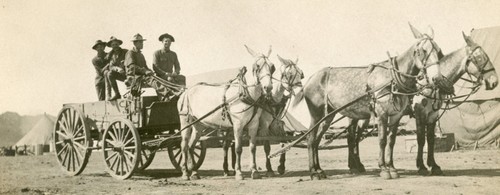
WW1-ERA-4-MULE-HORSE-TEAM-HEART-VALENTINE-RPPC-PHOTO
This is not a family photo, but is one of a WWI era mule team with muleskinners.

*******There is a strong family resemblance between my grandfather, my father, and my son. My husband saw the "uniform" photo and joked, "Yeah, well our boy (who is in the Army) would rather wear a dress than wear a Navy uniform." And I laughed and showed him the other photo with the boys in their fancy childhood "dresses." [I suspect they only dressed up for the photo - note John's bare feet.]

5-23-17 - since posting, we have noted the resemblance of these two to others - a cousin, some nephews. Families leave marks.


McCulloch County flowers (and such)

Everything in McCulloch County sticks, stings or bites (OK, just about everything). I know that is often said about Texas in general, but it is TRUE about McCulloch County.

We visited friends to harvest agarita for an attempt at making jelly.* Their place was alive with blooms and creatures enjoying the flowers.

I was thrilled to see the cactus blooming as I had not been happy with the blossoms I photographed in Uvalde/Real Counties.**

We took loads of photos, got a few fire ant bites, gathered agarita berries, and headed home.

I. Agarita/Algerita/Mahonia Trifoliolata*** harvest:

"Berries" on the bushes (protected by those sharp leaves)
DH and MD "beating the bushes"
Agarita harvest - there are bugs and ants and spiders, leaves and cactus and twigs, and all kinds of other stuff mixed in with the berries.

When you look close, you see some of the creatures and other "stuff" that is harvested along with the berries.


II. Cacti:


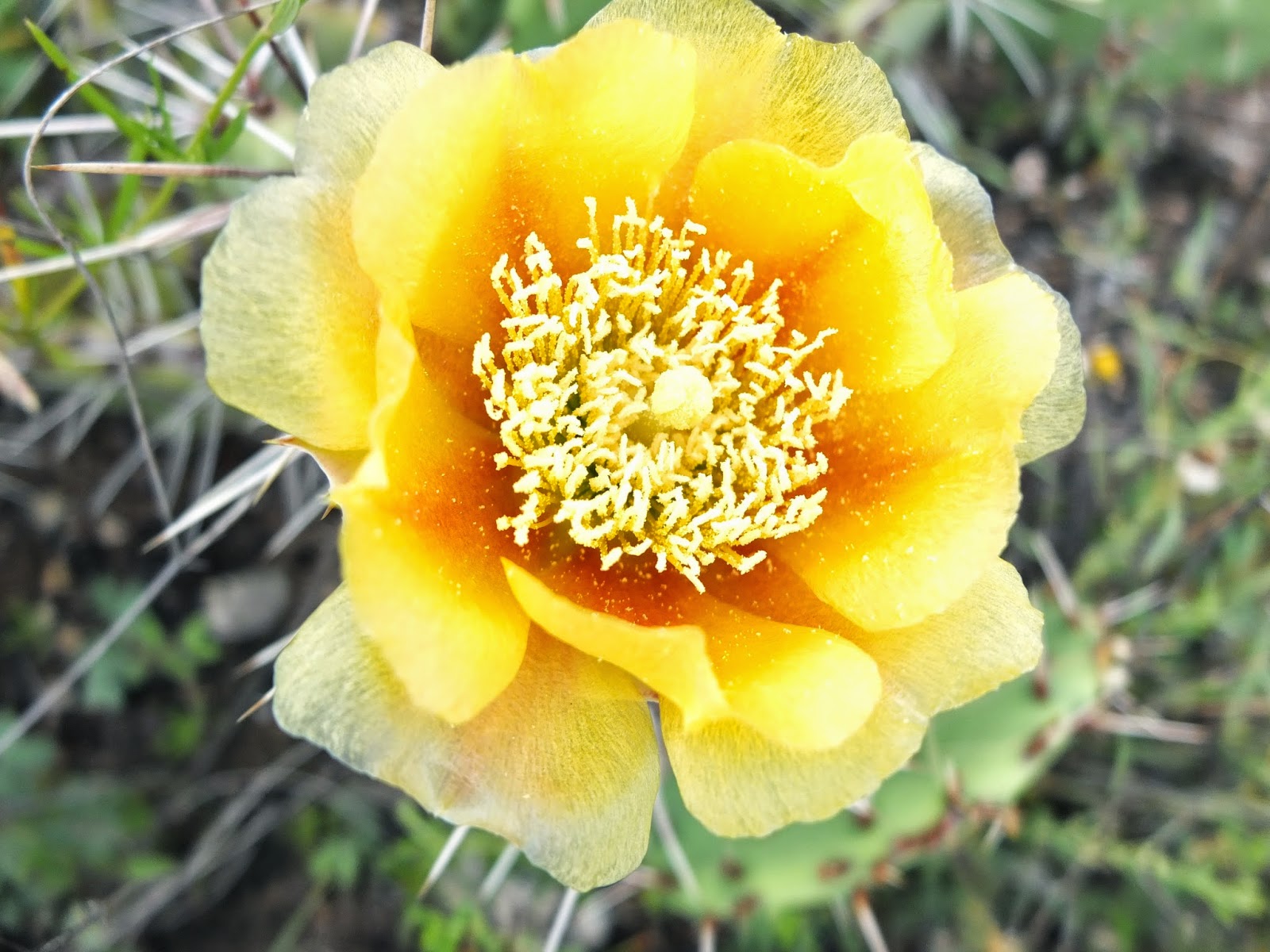
This is a lovely cactus (I think it is a cholla) and the blooms are incredible. The insects were enjoying them as well.


I am not sure I saw the bee when I was taking the photo.

But then he moved, digging in.


We talked about trying prickly pear jelly when the fruit (tunas) ripen. We decided to try the agarita first and decide about the cactus jelly later (with prickly pear you have to burn off the thorns). I will note that on one website I counted 24 varieties of prickly pear. I don't know which these are, but the blooms are truly stunning and the bees and other insects love them.


Prickly pear


Bees and other insects were everywhere - rolling in the pollen.


There are beetles further in the blossom as well as the bee.


 III. Other stuff:

The bloom was tiny and low-growing. I have no idea what it is.
Closeup you can see it has a very complex blossom.
Our friends have tried to get rid of this grass (sacahuista), but it is tough. We stopped because we saw yet another insect sheltering.****
This was as much a test of the camera as anything.
And there you are - not a bad photo of a Buckeye.***** And, yes, the "eyes" are used to scare off predators.
I think this is a ruellia, from the acanthus family. They are often called wild petunias.
Hairy Primrose
I knew immediately that it was a primrose, but I was unfamiliar with the variety until now.

Catclaw acacia, Acacia greggii

It is hard to ignore this small tree when blooming (soft pale yellow/white fluffy blooms) or when the beans are so lovely.

The thorns are profuse and nasty little devils.
It is a pretty little thing, but produces a nasty bur.
Trailing ratany******
The goathead bur (also known as the sandbur) is supposed to be nothing compared to that of the trailing ratany.


There are always familiar "favorites" on our walks and many plants and insects that are new to us. This spring has been a gift of colorful sights.


NOTES:

*More on the jelly adventure soon - watch for it.

**These areas are both "west Texas," but very different in "growing seasons" or maybe it is different varieties of prickly pear. Most of the cactus had already bloomed in the areas along the Frio River. Those I found blooming were usually inaccessible.

We started seeing pastures full of blooming cactus just north of the road from Mountain Home to Rocksprings and those on our friends' property were beautiful.

***http://www.wildflower.org/plants/result.php?id_plant=MATR3

****http://www.wildflower.org/plants/result.php?id_plant=NOTE  A Texas native, sacahuista can be used as an ornamental plant, but our friends tell us it is highly invasive and hard to kill. 

*****Buckeye: This butterfly is seen in the United States. It is also in some places in Mexico. This butterfly is brown and orange. It also has patterns on its wings. These patterns look like eyes. These are used to scare off predators. This scares off other animals because it does not look like a butterfly. [From http://lifecycleofbutterflies1.blogspot.com/]

****** http://www.wildflower.org/plants/result.php?id_plant=KRLA

See also:http://thebeepasture.blogspot.com/2014/06/early-summer-flowers-in-tandy-prairie.html

 
Other Resources (I am saving these for future reference. Some of these have been helpful.)

1. This site appears to be a work in progress, but there are things noted here that make me want to return and observe - http://www.inaturalist.org/places/mcculloch-county#taxon=47126

2. http://www.thehibbitts.net/Cactus/TXCactus/SpeciesAccounts4.html

3.  http://www.texasmonthly.com/content/texas-primer-sticker-bur

4.  https://uswildflowers.com/wfquery.php?State=TX