The greatest achievement was at first and for a time a
dream.
The oak sleeps in the acorn, the bird waits in the egg,
and in the highest vision of the soul a waking angel stirs,
Dreams are the seedlings of realities.
~ James Allen
 |
| Guardian Angel in St. Mary's Churchyard, Dingle |
What lies hidden can be such a surprise.
"There's a labyrinth!" shared DF. "You need to go look in the churchyard behind St. Mary's," he continued.
We had been to Mass earlier in the day and he wandered around to the back of the complex (there is a convent and national school in the same "block") where he found gardens and a labyrinth.
I, on the other hand, wishing to explore the Church of Ireland (St. James) had gone back to visit the tiny building and the churchyard beyond.
I often find C of I churches very similar to Catholic churches,* but these two neighbors (a three minute walk apart) could not be more different - in size, design, decoration, and certainly the churchyards. Each was special in its own way.
St. James Church of Ireland
One immediately notices the simplicity of the building. St James is plain. Only the window (clear glass) above the altar can be described as "elaborate."
 |
| The church is well off the street. |
 |
| Allegedly of Spanish design, St. James is a simple box (with belfry?)** |
 |
| St. James hosts concerts. There were about 5 people in the church when I arrived. They were discussing the placement of things for the evening concert and said I could stay. So I quickly looked around and headed outside. |
 |
| This wall-mounted shelf contained the missals and hymnals |
 |
| A simple window looks out on the churchyard. |
 |
| Then I headed out the door, fully expecting to head back to my room. |
 |
| I saw a kind of shed with broken gravestones and noticed that I could walk along the wall of the church. I thought I would get a better photo of the window and be done. |
 |
| I could see the graveyard was a bit overgrown along the side of the church. |
 |
| It is a beautiful window - made all the more spectacular by the simplicity of everything else. |
 |
| And then I turned to find the most amazingly overgrown, path-filled churchyard. The whole property is just behind some pubs and houses, but the yard goes back a significant distance - further than even I was willing to go. |
 |
| It was old and deserted and only slightly scary. |
 |
| The church from back in the trees. |
 |
| A profusion of ferns and primroses and other things. |
 |
| The graves are overcome with foliage. |
 |
| This is another place I would walk regularly, if I lived here. |
 |
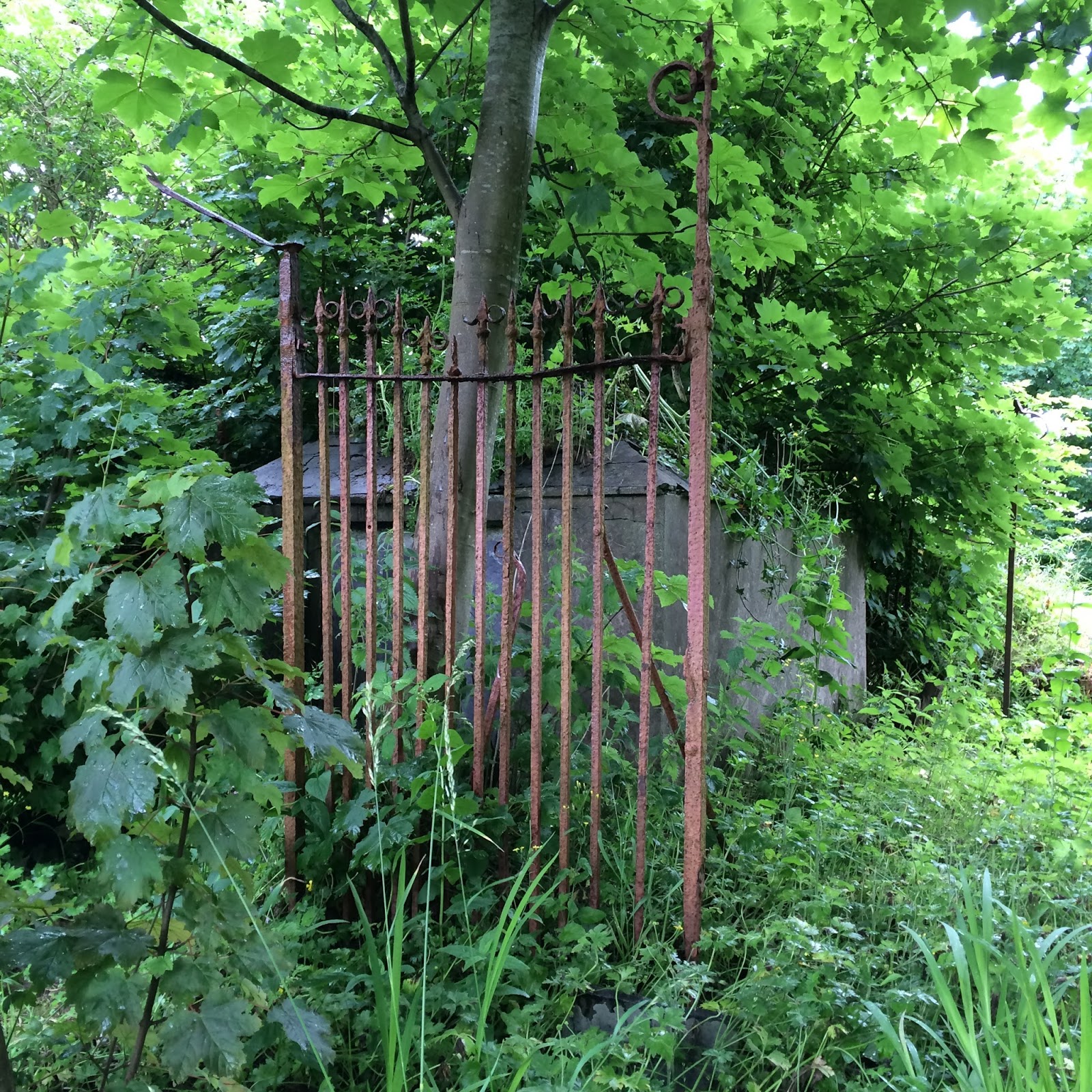
| Some interesting above-ground crypts. |
 |
| Broken stones, brambles, wildflowers (navelwort). |
 |
| Dingle is a port. This gull flew over as I prepared to leave St. James. |
St. Mary's Church
 |
| Behind the church. |
St. Mary's Church is a more typical parish church. The interior has votive candles and signs, stained glass, crucifixes, statues of saints, the way of the cross, and so on and so on. The churchyard is divided into multiple landscaped "gardens." There is the Family Tree garden, the Peace Labyrinth, and the graveyard for the sisters.
 |
| Angels guard the gate to the sisters' graveyard. |
 |
| Regimented in death as in life. Orderly. |
 |
| There were multiple levels with stairs and gates and well manicured walks. |
 |
| One can see beyond the gardens to the gate angel and the church. |
 |
| Some clouds moved in and I moved more quickly through the garden. |
 |
| Raindrops on the new growth of evergreen. |
 |
| The loveliest daylilies I saw on the trip. |
 |
| These were "walled" gardens. And one could see that the walls were added at intervals. |
 |
| At the corners one can recognize the differences. |
 |
| And some places it is dramatic - stones or bricks. |
 |
| And again. |
 |
| The most unruly growth was on the walls. The rest of the garden was quite orderly. |
 |
| The sun was setting behind a statue of St. Joseph. |
 |
| The shrines were all part of the older gardens. |
 |
| The Family Tree Garden. Each tree is sponsored by a different family. |
 |
| The Peace Labyrinth. I knew I would have to walk it. |
 |
| I found the start, but was interrupted by a rain shower before reaching the center. |
 |
| A crab apple within the labyrinth. |
 |
| I took refuge here until the shower passed. |
 |
| People often leave stone markers - on trails, on graves, and apparently at the center of the labyrinth. |
 |
| Only a few wildflowers escaped the gardener's attentions...this primrose... |
 |
| ...and some white clover. |
 |
| And another bird flew over, marking the end of this walk. |
NOTES:
* We talk about "high" church Episcopal Churches as being "more Catholic than the Catholics." [Forgiveness requested - no harm is intended. It is simply that some appear more conservative than the Catholics seem to be - especially now with Pope Francis in Rome.]
**The story is the church was built by the Spaniards and was where Irish pilgrims would start their journey to Santiago de Compostela, the shrine of St. James the Greater. Legend has it that St. James' remains were brought to Spain and a cathedral was built on the site where these remains (don't ask me) where rediscovered by a shepherd (in 813).
Now that I read all of this, I wonder if this church was not originally a Roman Catholic church that was "re-purposed" by the prods...hmm. Anyway, pilgrims would sail from Dingle to A Coruña (about a 600 mile voyage) in northern Spain and then walk to the shrine (some 63 km - a 14 hour walk). People from all over Europe continue to make a pilgrimage there today.
The pilgrimage, The Way of St. James, is marked by a scallop shell design. There are many routes.
Here is an article on Kerry pilgrimages: http://www.irishcatholic.ie/article/pilgrims-called-kerry%E2%80%99s-camino
***https://naomhmuire.wordpress.com/ (the Church website).